
Safety
How a Roadside Tire Job Is Done Safely
The technician's first job at your car is the setup, not the tire. Here is how Emergency Mobile Tire Repair sets up, lifts, torques, and inflates, and what we ask of you while it happens.
- Hazards on, cones out, work on the side away from traffic
- Jack on the lift point, a stand under the car, torque in a star pattern
- If the spot is not safe, we say so and a tow is the call
Before the tire comes off
The Spot Decides Everything
A tire job is routine in a driveway. On a highway shoulder it is only routine when the spot allows it. So the first thing we ask on the call is where the car is and how much room there is.
A wide shoulder, an exit ramp, or a parking lot usually works. A narrow shoulder with traffic close, a blind curve, or a bridge usually does not. Then a tow to a safer spot comes first, and we say so before dispatch.
This is not a judgment on you. Florida's Move Over law requires passing drivers to move over a lane, or slow down where they cannot. Even so, a technician cannot lift a car and pull a wheel with trucks passing a few feet away.
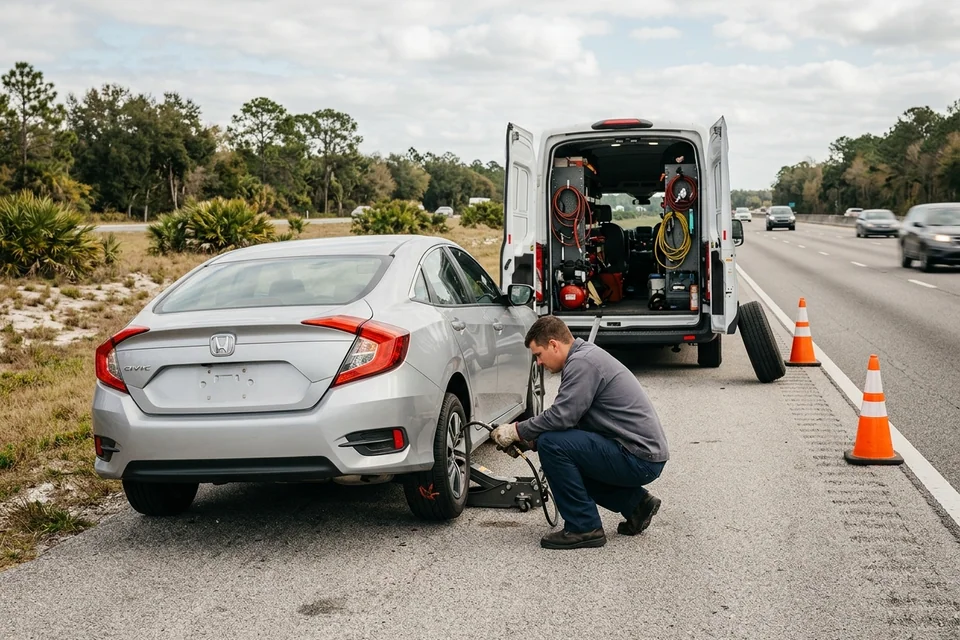
At the car
From Setup to Drive Away
- 01
Mark the spot
Hazards on, cones behind the car. The van parks to shield the work side where the layout allows.
- 02
Work the safe side
The technician works on the side away from traffic. A flat on the traffic side with no room changes the plan.
- 03
Lift and hold the car
Parking brake set, wheels chocked, jack on the lift point, a stand under the car. No one works under a car held only by a jack.
- 04
Torque and inflate
Lug nuts tightened in a star pattern to the vehicle torque specification, following Tire Industry Association guidance. Pressure set to the placard on the driver's door jamb.
- 05
Check before you go
A look at the other tires, the spare's limits if it went on, and the next step.
What you should do
Your Part While the Work Is Done
Stay belted in or stand well clear
On a highway shoulder, the safest place is usually inside the car with your belt on, or well off the road behind a barrier. The technician tells you which. Do not stand between the car and traffic, or near the jacked side.
Hazards on, kids and pets in the car
Leave the hazard lights running the whole time, even in daylight. A car on a jack is not a place to wander around. Pets stay belted or crated. Kids stay in their seats.
Do not help with the lift
Pushing on the car or getting in and out on the jack moves the load. Wait until the technician says the car is down.
Why torque and pressure matter after you leave
Lug nuts that are too loose can back off. Too tight can stretch a stud or warp a rotor. So the torque wrench is the last tool on the wheel, not the impact gun.
The placard pressure is set for your car's weight and handling. The sidewall number is a maximum, not a target. Your spare has its own limits, printed on it.
When a tow is the safer call
No shoulder, a lane blocked, a bridge or a curve, a damaged wheel, or more than one tire down. Then we tell you a tow is the right call, before anyone rolls.
Where you are stopped
Driveway, Wide Shoulder, or No Shoulder
| Criteria | Driveway or parking lot | Wide highway shoulder | Narrow or no shoulder |
|---|---|---|---|
| Mobile tire service | Yes. The simplest setup | Yes, when the car is fully off the lane with room on the safe side | Usually not. A tow comes first |
| Where you wait | Anywhere clear of the work | Belted in the car, or well off the road behind a barrier | In the car, belted, hazards on |
| Which side we work | Either | Away from traffic. A traffic-side flat needs more room | Neither side is safe |
| What we ask on the call | Where the car is and where we can park | How far off the lane you are and what the shoulder looks like | Stay put. We point you to help |
Mobile tire service
- Driveway or parking lot
- Yes. The simplest setup
- Wide highway shoulder
- Yes, when the car is fully off the lane with room on the safe side
- Narrow or no shoulder
- Usually not. A tow comes first
Where you wait
- Driveway or parking lot
- Anywhere clear of the work
- Wide highway shoulder
- Belted in the car, or well off the road behind a barrier
- Narrow or no shoulder
- In the car, belted, hazards on
Which side we work
- Driveway or parking lot
- Either
- Wide highway shoulder
- Away from traffic. A traffic-side flat needs more room
- Narrow or no shoulder
- Neither side is safe
What we ask on the call
- Driveway or parking lot
- Where the car is and where we can park
- Wide highway shoulder
- How far off the lane you are and what the shoulder looks like
- Narrow or no shoulder
- Stay put. We point you to help
Safety questions
Safety Questions
Should I drive on a flat tire?
No. Driving on a flat damages the tire and the wheel. Pull over safely, put on hazards, and call us.
Can you come to hotels, parking lots, or the highway?
Yes. Hotels, theme park areas, lots, driveways, workplaces, and highway shoulders where it is safe to work. We confirm the spot on the call.
Should I stay in the car while you work?
On a highway shoulder, usually yes, belted in, unless the technician asks you to stand well clear. In a driveway or lot, anywhere clear of the jacked side.
What if you say my spot is not safe?
Then a tow to a safer place comes first. We tell you that before dispatch, and we point you to the right help.
On every job
Practices You Can Expect at Your Car
Cones and hazards
The spot is marked before any tool comes out.
A stand, not just a jack
The car is held on a stand before anyone works near it.
Torque wrench last
Star pattern, to spec. The impact tool does not finish the job.
Placard pressure
Set to the door jamb number, not the sidewall maximum.
Repair availability depends on tire condition, damage location, tire size, and safety. If the tire cannot be safely repaired, we help with the next best option.
Why this matters
What Careful Setup Does for You
You are not standing in traffic
Where you wait is settled before the work starts.
The car leaves the way it should
Correct torque and pressure, not a problem later.
No wasted trip
If a tow is the call, you hear it before dispatch.
Keep reading
Related Pages
- About Emergency Mobile Tire RepairHow the business works.
- Our companyBase and coverage.
- How a job worksCall, describe it, hear the plan.
- Service vehicles and equipmentWhat a mobile unit carries.
- ReviewsWhere to leave one.
- Highway tire assistanceI-4, US-27, and the Turnpike.
- Contact and hoursPublished hours and every way to reach us.
Stopped Somewhere Right Now?
Call Emergency Mobile Tire Repair at (352) 531-6319 and describe the spot. We tell you honestly whether mobile service is safe there or a tow should come first.
(352) 531-6319