
Spare Tire Installation
We Put Your Spare On So You Can Move
No jack, lug nuts that will not budge, a shoulder too tight to kneel on, or a spare you are not sure about. Call Emergency Mobile Tire Repair. We install the spare where you are stopped, set its pressure, and tell you how far it can safely take you.
- Jack on the correct lift point, lug nuts torqued in a star pattern, pressure set
- We check the spare before it goes on. A flat or cracked spare is not a fix
- Compact spares carry a speed and distance limit printed on the sidewall
- Locking lug nuts? Have the key ready. We need it to get the wheel off
- Driveways, hotel and theme park area lots, workplaces, and shoulders where it is safe to stop
What this service is
What Spare Tire Installation Covers
Spare tire installation is getting the spare already in your vehicle onto the car and inflated so you can move. The technician secures the car, lifts it at the correct point, removes the flat, mounts the spare, torques the lug nuts, and sets the pressure. The flat goes in the trunk for inspection later.
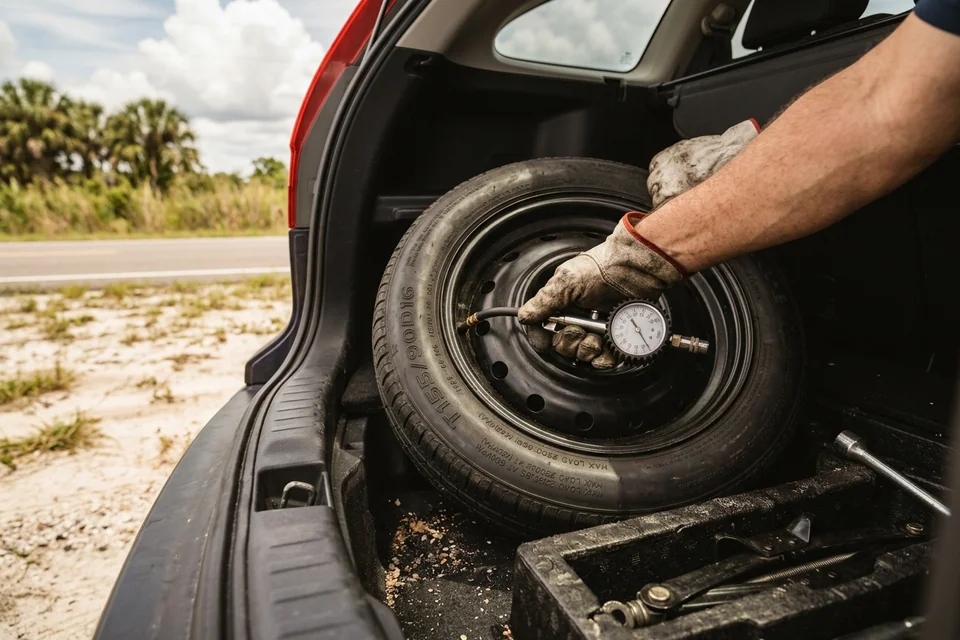
Before anything comes off, we look at the spare. Spares sit for years and lose air. Compact spares usually need a higher pressure than the regular tires, and the figure is printed on the spare itself. A spare with cracked rubber or a bent wheel stays in the trunk, and we talk through the next option.
If there is no spare at all, call anyway. Many newer cars ship with an inflator kit or run-flat tires instead. Our no-spare guide explains those, and repair on site or a replacement may still get you moving.
We explain pricing before any work begins. We serve Clermont, Four Corners, Orlando, Kissimmee, and the surrounding Lake, Orange, Osceola, Polk, Seminole, and Sumter counties, roughly 50 miles or an hour from Clermont. Outside that range, call anyway.
Do it yourself or call
When Calling Beats Changing It Yourself
If you are fully off the road, have a working spare and jack, and know the steps, put it on. These are the situations where calling is the better choice.
The lug nuts will not move
Impact-tightened or rusted lug nuts defeat the factory wrench. The technician brings the tools to break them loose without rounding them off.
No safe place to kneel
A narrow shoulder on I-4, US-27, or the Turnpike is no place to lie beside a car. We work on the side away from traffic, or tell you a tow is safer.
No jack, or the wrong jack
Rentals and used cars often come without one, or with one that does not fit the lift point. We bring our own.
The spare is checked first
Pressure, cracking, and the wheel are inspected before the flat comes off. A spare that will not hold air does not go on.
You have not changed a tire before
That is fine. You stay clear of the car, we do the work, and you leave knowing the spare's limits.
Highway speeds explained
A compact spare changes how the car brakes and handles. We tell you what the sidewall says and where the flat should go next.
On arrival
What the Install Includes
The same sequence in a driveway or on a shoulder. Each step matters for a wheel that stays on.
Secure the car
Parking brake set, the car on firm level ground, and the technician working on the side away from traffic.
Lift at the correct point
The jack goes on the lift point the manufacturer specifies, not on the sill or the floor pan.
Remove the flat
Lug nuts loosened before the wheel leaves the ground, then the wheel comes off and the hub face is checked.
Mount the spare
The spare goes on and the lug nuts are run up by hand first so the wheel sits flat against the hub.
Torque in a star pattern
Lug nuts are tightened across from each other in sequence so the wheel seats evenly and stays tight.
Set the pressure
Inflated to the figure printed on the spare, which on compact spares is usually higher than the regular tires.
Stow the flat
The damaged tire and wheel go in the trunk or the spare well so a shop or our technician can inspect it later.
Repair availability depends on tire condition, damage location, tire size, and safety. If the tire cannot be safely repaired, we help with the next best option.
Step by step
From Stopped to Rolling on the Spare
- 01
Get off the road and call
Hazards on, as far from traffic as you can get. Tell us where you are, what kind of spare you have, and whether the lug nuts are locking.
- 02
We confirm the plan
Spare install, repair on site, or a replacement if the spare is no good. You get an honest ETA when a technician is available.
- 03
The technician arrives with the tools
Jack, torque wrench, compressor, and lug sockets. If your wheels have a locking lug nut, have the key in hand.
- 04
Spare on, limits explained
Lug nuts torqued, pressure set, the flat stowed. You leave knowing the spare's speed and distance limit and where the flat should go next.
Decide
Drive on the Spare, or Replace Where the Car Sits?
Once the spare is on, the damaged tire still needs dealing with. Three ways that can go.
| Criteria | Spare on, drive to a shop | Spare now, replacement at home | Replace at the roadside |
|---|---|---|---|
| Pick this when | The spare is sound, the trip is short, and a shop is within the spare's limits | You want off the shoulder now and the tire chosen without pressure | There is no usable spare, or the car cannot move safely on one |
| What you drive away on | The spare, at its printed speed limit | The spare, then a matched tire at your driveway | A replacement tire mounted at the car, where mobile mounting is available |
| The damaged tire | In the trunk, inspected at the shop | Inspected when the technician returns to replace it | Dismounted on site |
| Highway driving | Compact spares are not built for sustained highway speed. Right lane, short trip | The same limits until the replacement is on | Normal once the matched tire is on |
| What to ask on the call | Is my spare safe to go on | Can you come back to the house for the replacement | Where does the replacement tire come from |
Pick this when
- Spare on, drive to a shop
- The spare is sound, the trip is short, and a shop is within the spare's limits
- Spare now, replacement at home
- You want off the shoulder now and the tire chosen without pressure
- Replace at the roadside
- There is no usable spare, or the car cannot move safely on one
What you drive away on
- Spare on, drive to a shop
- The spare, at its printed speed limit
- Spare now, replacement at home
- The spare, then a matched tire at your driveway
- Replace at the roadside
- A replacement tire mounted at the car, where mobile mounting is available
The damaged tire
- Spare on, drive to a shop
- In the trunk, inspected at the shop
- Spare now, replacement at home
- Inspected when the technician returns to replace it
- Replace at the roadside
- Dismounted on site
Highway driving
- Spare on, drive to a shop
- Compact spares are not built for sustained highway speed. Right lane, short trip
- Spare now, replacement at home
- The same limits until the replacement is on
- Replace at the roadside
- Normal once the matched tire is on
What to ask on the call
- Spare on, drive to a shop
- Is my spare safe to go on
- Spare now, replacement at home
- Can you come back to the house for the replacement
- Replace at the roadside
- Where does the replacement tire come from
Compact spare limits are printed on the spare's sidewall and in the owner's manual. Check them before you drive.
Know before you call
Spare Tire Facts Worth Knowing
Which spare do you have
- Full-size matching spare: the same tire and wheel as the other four. Drive normally, then put the repaired or replaced tire back in the well
- Full-size non-matching spare: the right size on a plain steel wheel. Fine for normal driving, but swap it back once the damaged tire is dealt with
- Compact temporary spare, the donut: narrower, less tread, higher pressure, and a speed and distance limit printed on the sidewall
- Inflatable or folding spare: found on some older and specialty vehicles. It must be inflated with the supplied kit before it can be used
- No spare: an inflator kit, sealant, or run-flat tires instead. Call us, and read the no-spare guide
Is the spare usable
Pressure first. A spare that has sat in the well for years is usually low, and a compact spare needs more pressure than the regular tires. The correct figure is printed on the spare. We bring a compressor and set it before the car comes down.
Then the rubber and the wheel. Cracking in the sidewall, a flat spot, or a bent rim means the spare should not go on. Most tire makers' owner's manuals advise inspection after six years and replacement by ten. That applies to a spare that has not touched the road.
Why compact spares have limits
A donut has a smaller contact patch and less tread than the tire it replaces. It grips less in rain, takes longer to stop, and turns at a different rate than the other wheels. That difference can confuse anti-lock brakes and strain an all-wheel-drive system. The manual and the sidewall give the speed and distance limit. Treat it as a bridge to a shop, not a tire.
When a spare install is not the answer
- The spare is flat and will not hold air, or the rubber is cracked
- The locking lug nut key is missing. Without it the wheel cannot come off. Check the glove box and the trunk kit before you call
- The wheel itself is bent or cracked, often after a blowout or a curb strike
- More than one tire is down. One spare does not cover two flats
- The shoulder is too narrow or traffic is too close to work safely. We say so, and a tow is the safer call
In those cases we move to repair on site when the damage allows it, or to a replacement tire where the car sits.
After the spare is on
- Get the damaged tire inspected soon. A tread puncture within repair limits may be fixable. Sidewall damage is a replacement
- Check the spare's pressure again the next morning. Old spares can lose air after being inflated
- Drive at the spare's printed limit, stay in the right lane on the highway, and keep the trip short
- Once the regular tire is back on, return the spare to the well and note its pressure for next time
Spare tire questions
Spare Tire Questions
Can you help if I don't have a spare?
Often yes. Call us with the tire size or send a photo of the sidewall and we talk through options: repair on site, or a replacement tire where the car sits.
What if my spare is flat?
We bring a compressor and inflate it to the pressure printed on the spare. If it will not hold air, or the rubber is cracked, we talk through repair or replacement instead.
How far can I drive on a spare?
Check the sidewall. Compact spares carry a speed and distance limit printed on the tire and listed in the owner's manual. Full-size spares can be driven normally. Plan a shop visit or a replacement soon either way.
Should I drive on a flat tire?
No. Driving on a flat damages the tire and the wheel, and can ruin a tire that was repairable. Pull over safely, put on hazards, and call us.
How fast can you arrive?
Response times vary by your location, traffic, and technician availability. We give you an honest ETA before dispatching.
Can you come to hotels, apartments, parking lots, or job sites?
Yes. We regularly help drivers at hotels, theme park areas, lots, driveways, workplaces, and on the highway where it is safe to stop.
Keep reading
Related Services and Guides
- All mobile tire servicesRepair, replacement, jump starts, lockouts, and fuel delivery.
- Mobile tire repairHave the flat inspected for a repair once the spare is on.
- Flat tire helpThe first five minutes after a tire goes flat.
- Mobile tire replacementWhen the flat is past repair and needs a new tire where the car sits.
- No spare tire guideInflator kits, sealant, run-flats, and what to do without a spare.
- Tire glossaryDonut, placard, load index, and the other terms on this page.
- Check your service areaEnter a ZIP or city to see if we cover you.
- Contact and hoursPublished hours and every way to reach us.
Stuck With a Spare You Cannot Get On?
Call Emergency Mobile Tire Repair at (352) 531-6319. Tell us where you are and what kind of spare you have. We install it, set the pressure, and give you an honest ETA when a technician is available.
(352) 531-6319