
Tire and Roadside Glossary
Tire Terms, Explained in Plain Words
The words a technician uses on the call, defined in one place. Emergency Mobile Tire Repair asks every caller for the tire size from the sidewall. So this page starts there, then works through parts, damage, repairs, and spares.
- How to read P225/60R17 and the load and speed marks next to it
- Where the DOT date hides and what the four digits mean
- Bead, shoulder, sidewall, and the other parts we name on site
- Plug, patch, and the plug-patch repair the industry treats as standard
- Spare, run-flat, dispatch, and ETA, and what each means for your call
Why a glossary
Why These Words Matter on the Call
When you call with a tire problem, we ask a few things: where you are, what happened, and the size on the sidewall. The answers decide whether the tire can be repaired at the car, needs a replacement, or is better off at a shop.
Most drivers have never read a sidewall. The numbers are small, the letters look random, and the owner's manual is in a drawer at home. This page explains each mark in one to three sentences and ties it to what it means on a mobile job.
Use it two ways. Read the sidewall section before you call so you can give us the size. Or look up a term after the call, when the technician said bead leak or plug-patch and you want to know what that meant.
Nothing here is a promise about your tire. Repair availability depends on tire condition, damage location, tire size, and safety. The glossary helps you understand the decision. The technician makes it at the car.
Before you call
Read Your Tire Sidewall in Five Steps
- 01
Find the size string
Look on the sidewall for a group like P225/60R17. It is the largest set of numbers and letters, usually near the wheel. The same size is also on the placard inside the driver's door.
- 02
Read width, ratio, and diameter
225 is the tread width in millimetres. 60 is the sidewall height as a percentage of that width. R means radial. 17 is the wheel diameter in inches. All four parts matter for a match.
- 03
Find the load and speed marks
Right after the size you will see something like 98H. The number is the load index and the letter is the speed rating. A replacement should meet or exceed both.
- 04
Find the DOT date
Look for DOT followed by a run of letters and numbers. The last four digits are the week and year the tire was made, for example 2322 for the 23rd week of 2022.
- 05
Photograph it and send it
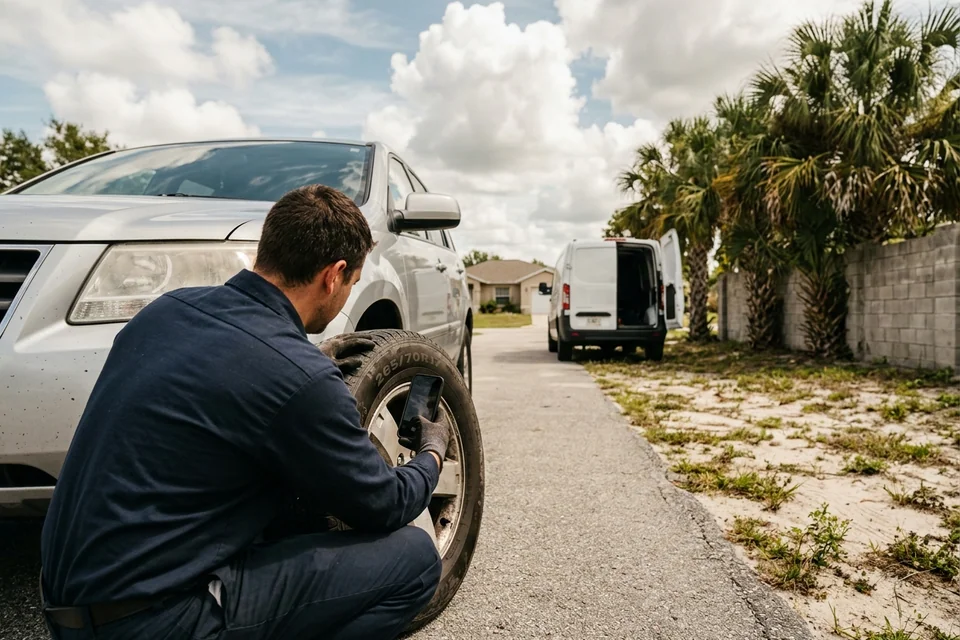
Take one clear photo of the size string and one of the DOT code. Send them to us or read them out on the call. If you cannot make them out, that is fine. We help.
The glossary
Tire and Roadside Terms
Reading the sidewall
Tire size: the string such as P225/60R17 molded into the sidewall. It names the width, aspect ratio, construction, and wheel diameter. It is the first thing we ask for on the call because it decides what fits.
P, LT, and ST prefix: the letter or letters before the size. P means passenger car, LT means light truck, and ST means special trailer. An ST tire belongs on a trailer only, which matters when we help with trailer tires where available.
Section width: the first number, the width of the tire in millimetres. 225 means 225 millimetres across the widest part of the tire.
Aspect ratio: the number after the slash, the sidewall height as a percentage of the width. A lower number means a shorter, stiffer sidewall.
R: radial construction, the way nearly every modern car tire is built. The plies run across the tire from bead to bead.
Wheel diameter: the last number in the size, the rim size in inches. A 17 goes on a 17-inch wheel and nothing else.
Load index: the number after the size, for example 98. It stands for the maximum weight one tire can carry at its rated pressure. A replacement should meet or exceed the number on the placard.
Speed rating: the letter after the load index, for example H. It is the top speed the tire is built to sustain. Match it to the placard rather than guessing.
Service description: the load index and speed rating together, such as 98H. Technicians read them as one unit.
DOT code: the run of letters and numbers after the letters DOT. It identifies the plant, size, and batch. The last four digits are the date.
Tire date code: the last four digits of the DOT code, week then year. 2322 is the 23rd week of 2022. Many manufacturers advise an inspection after six years and replacement by ten, whatever the tread looks like.
Placard: the sticker on the driver's door jamb. It lists the original tire size and the correct cold pressure for front and rear. When we set pressure on site, this is the number we use.
Max pressure: the pressure molded on the sidewall. It is the most the tire can safely hold, not the amount to run. The placard number is lower and is the right one.
Cold pressure: the pressure in a tire that has not been driven for a few hours. Every placard and every gauge reading assumes a cold tire, because driving heats the air and raises the number.
M+S: mud and snow, a mark that the tread pattern is designed for some mud and light snow. It describes the tread shape. It is not a winter tire rating.
Parts of a tire
Tread: the patterned rubber that touches the road. It is the only part of a tire where U.S. Tire Manufacturers Association repair procedures allow a repair.
Shoulder: the rounded edge where the tread meets the sidewall. Damage here is not repairable because the tire flexes too much in that spot.
Sidewall: the flat face between the shoulder and the bead. It carries the markings and flexes with every turn of the wheel. A puncture, cut, or bulge here means replacement.
Bead: the stiff, wire-reinforced inner edge that seals against the wheel. When a technician dismounts a tire, the bead is what comes off the rim.
Inner liner: the airtight rubber layer inside a tubeless tire. A patch is applied here, from the inside, which is why a proper repair means taking the tire off the wheel.
Belts and plies: the layers of cord and steel under the tread and in the sidewall. They give the tire its shape and strength. A tread puncture goes through the belts, and the repair seals the hole in them and in the liner.
Valve stem: the short rubber or metal stem you add air through. It can crack with age or leak at its core. Valve stem fixes are something we do on site.
Valve core: the small spring-loaded insert inside the stem. A loose or dirty core is a common slow leak and a quick fix.
TPMS sensor: the small sensor inside the wheel, usually attached to the valve stem, that reports pressure to the dash on direct systems. Replacing one is not a listed service. Ask on the call.
Wheel and rim: the wheel is the metal part the tire mounts on, and the rim is its outer edge where the bead seats. Corrosion or a bend on the rim is a common cause of a bead leak.
Damage and failure
Puncture: a hole through the tread from a nail, screw, or other object. In the tread area and within repair limits, this is the classic on-site repair.
Slow leak: air loss over days or weeks rather than minutes. The pressure light returns after every fill. Finding it means checking the tread, the valve, and the bead in turn.
Bead leak: air escaping between the bead and the rim, often from corrosion, dirt, or a bent rim. It is fixed by dismounting, cleaning or sealing the seat, and remounting.
Valve stem leak: air escaping at the stem or its core. Often the simplest leak to fix and one we handle at the car.
Sidewall bulge: a bubble on the sidewall where the inner layers have separated, usually after a pothole or a curb. The tire can fail without warning. It is a replacement, and our sidewall damage guide explains why.
Blowout: sudden, total loss of air, often with a bang and a pull to one side. Keep the wheel straight, ease off the gas, and get to the shoulder. The tire is a replacement.
Run-flat damage: a run-flat tire driven after losing pressure has been used past its design, even if it looks fine. Most manufacturers call for replacement rather than repair.
Dry rot: fine cracks in the sidewall or between tread blocks from age, sun, and sitting. Common on spares and trailer tires. A dry-rotted tire is a replacement, not a repair.
Tread separation: the tread peeling away from the belts, felt as a thump that grows with speed. Stop driving. The tire is a replacement.
Cupping: scalloped, uneven wear around the tread, usually from worn suspension or a balance problem. It is a sign for a shop, not something a roadside visit fixes.
Driven flat: a tire that was rolled on with no air. The sidewall grinds against itself and the damage is inside. Industry guidance calls for an inside inspection before any repair, and often the answer is replacement.
Repair terms
Plug: a sticky rubber strip pushed into the puncture from the outside without removing the tire. It fills the hole but does not seal the inner liner. Tire Industry Association guidance treats a plug alone as a temporary fix.
Patch: a rubber patch bonded to the inner liner from the inside. It seals the liner but leaves the puncture channel open, so water can reach the belts.
Plug-patch: a one-piece repair with a stem that fills the hole and a patch that seals the liner, applied from the inside. It is the repair the industry treats as proper for a tread puncture. It is what we mean by repairing a tire on site when it qualifies.
Repairable area: the central tread, away from the shoulder, where a puncture can be repaired. Outside that area the tire flexes too much for a repair to hold.
Repair size limit: the maximum puncture diameter industry guidelines allow a repair for. A larger hole, a cut, or two punctures close together push the tire to replacement. The technician measures it at the car.
Dismount and remount: taking the tire off the wheel and putting it back. A proper plug-patch needs it, because the work is done from the inside.
Torque: how tight the lug nuts are. They are tightened to the maker's figure so the wheel seats evenly and stays put. Too loose is dangerous, and too tight can damage the studs or the brake rotor.
Star pattern: the crisscross order for tightening lug nuts, across the wheel rather than around it. It is how a wheel goes back on straight.
Balancing: adding small weights to the wheel so it spins without wobble. It needs a balancing machine, so it is shop work and not a stated on-site service. Ask on the call if you need it.
Alignment: adjusting the angles of the wheels so the car tracks straight and the tires wear evenly. Shop only.
Sealant: the liquid in an inflator kit or an aerosol can that coats the inside of the tire to stop a small leak. It is temporary, can affect the TPMS sensor, and many shops will not repair a tire that has had sealant in it. Tell us if you used it.
Spares and roadside terms
Full-size spare: a fifth tire the same size as the other four. It can be driven like a normal tire, though it may be older and lower on air than you expect. Check its pressure and its date.
Compact spare: the small, narrow spare, often called a donut. It has a speed limit and a distance limit printed on the tire. It is a bridge to a repair or replacement, not a fix.
Inflator kit: the compressor and sealant bottle that replaces the spare in many newer cars. It works only on small tread punctures and does nothing for sidewall damage or a blowout.
Run-flat: a tire with stiff sidewalls that can be driven a limited distance at reduced speed after losing pressure. The limit is set by the tire maker and printed in the owner's manual. Sidewall marks vary by brand, such as RFT, ROF, ZP, SSR, or DSST.
Mobile tire repair: the technician comes to the vehicle and repairs or replaces the tire where it sits. Driveways, lots, workplaces, hotels, and highway shoulders where it is safe to stop.
Tow: moving the car on a truck to a shop. The right call when the car cannot be safely worked on where it is, the wheel is damaged, or no tire is available.
Dispatch: the moment we send a technician to you. Pricing is explained before any work begins, and a cancellation after a technician has been dispatched may carry a trip fee.
ETA: estimated time of arrival. We give you an honest one on the call based on your location, traffic, and technician availability. It is an estimate, not a promise.
Estimate: the price we explain before any work begins. Quotes are estimates until the technician sees the tire, because damage location and tire condition can change the plan.
Repair methods
Plug, Patch, or Plug-Patch?
Three words that sound alike and mean different things. Industry repair guidelines favor the third.
| Criteria | Plug | Patch | Plug-patch |
|---|---|---|---|
| What it is | A rubber strip pushed into the hole from the outside | A rubber patch bonded to the inner liner | A one-piece stem and patch applied from the inside |
| Where it is applied | From the outside, tire still on the wheel | From the inside, tire off the wheel | From the inside, tire off the wheel |
| What it seals | The puncture channel only | The inner liner only | Both the channel and the liner |
| Industry standing | Treated as temporary by industry repair guidelines | Incomplete on its own, because the channel stays open | The accepted standard for a tread puncture |
| When we use it | Not as a lasting repair | Not on its own | When the puncture is in the tread and within repair limits |
What it is
- Plug
- A rubber strip pushed into the hole from the outside
- Patch
- A rubber patch bonded to the inner liner
- Plug-patch
- A one-piece stem and patch applied from the inside
Where it is applied
- Plug
- From the outside, tire still on the wheel
- Patch
- From the inside, tire off the wheel
- Plug-patch
- From the inside, tire off the wheel
What it seals
- Plug
- The puncture channel only
- Patch
- The inner liner only
- Plug-patch
- Both the channel and the liner
Industry standing
- Plug
- Treated as temporary by industry repair guidelines
- Patch
- Incomplete on its own, because the channel stays open
- Plug-patch
- The accepted standard for a tread puncture
When we use it
- Plug
- Not as a lasting repair
- Patch
- Not on its own
- Plug-patch
- When the puncture is in the tread and within repair limits
Repair availability depends on tire condition, damage location, tire size, and safety. If the tire cannot be safely repaired, we help with the next best option.
Glossary questions
Glossary Questions
What if I don't know my tire size?
No problem. Send a photo of the tire sidewall or call us and we help you read it. The size is also on the placard inside the driver's door.
What does the DOT date mean?
The last four digits of the DOT code are the week and year the tire was made. 2322 is the 23rd week of 2022. Many manufacturers advise an inspection after six years and replacement by ten, even with good tread.
What is the difference between a plug and a patch?
A plug fills the hole from the outside. A patch seals the liner from the inside. A plug-patch does both in one piece and is the repair the industry treats as standard. That is the repair we do when a puncture qualifies.
Go deeper
Where Each Term Group Leads
Each group of terms has a page that puts them to work.
Repair terms in practice
Which punctures qualify for a plug-patch and how the repair is done at the car.
Learn moreSlow leaks, bead leaks, valve stems
How we find where the air is going once you know a tire is leaking.
Learn moreSidewall bulges and cuts
Why sidewall damage is a replacement and how to spot it before it fails.
Learn moreTPMS and the pressure light
Steady, flashing, or comes and goes: what the light means and what to do.
Learn moreSpares, run-flats, and inflator kits
Your options when the trunk has no spare.
Learn moreWhen the tire is a replacement
Replacement labor at the car where available.
Learn more
Why it helps
What Knowing These Terms Does for Your Call
You do not need any of this to call us. It just makes the call shorter and the decision clearer.
The size question gets answered
The first thing we ask is the size. Reading P225/60R17 and 98H off the sidewall means we can talk about a match straight away.
You understand the repair decision
When the technician says the puncture is in the shoulder, you know why that means replacement instead of a plug-patch.
You spot a replacement before you drive
A bulge, dry rot, or a DOT date past ten years each mean the tire is done. Knowing the words helps you decide to stop.
You describe the leak better
A hiss at the valve, a wet ring at the rim, or a nail head in the tread each point to a different fix. Naming it helps us plan.
You know what the spare can do
Compact, full-size, inflator kit, or run-flat each have different limits. You know which you have and how far it can take you.
Keep reading
Related Pages
- All tire resourcesGuides, this glossary, and the cost and mobile versus shop pages in one place.
- Mobile tire repairWhat we repair at the car and when a repair is not the right call.
- Plug and patch repairWhich punctures can be fixed and how.
- Slow leak diagnosisPuncture, valve stem, or bead: finding where the air goes.
- Sidewall damage guideBulges, cuts, and why the sidewall cannot be repaired.
- Tire pressure light guideWhat a steady, flashing, or on-and-off light means.
- No spare tire? Your optionsInflator kits, run-flats, and mobile replacement.
- Mobile tire replacementWhen the tire cannot be repaired and a new one goes on at the car.
- Frequently asked questionsTen short answers about arrival, area, and pricing.
- Contact and hoursPublished hours and every way to reach us.
Read the Sidewall, Then Call
Call Emergency Mobile Tire Repair at (352) 531-6319 with the size, or send a photo and we read it with you. We explain pricing before any work begins and give you an honest ETA when a technician is available.
(352) 531-6319