
No Spare Tire Guide
Flat Tire and No Spare? Here Are Your Options
Many newer cars have no spare at all. You have four ways forward: the inflator kit in the trunk, a run-flat tire if you have one, mobile repair or replacement where the car sits, or a tow. This guide explains what each does to the tire. Emergency Mobile Tire Repair talks through the options with you on the call.
- The sealant kit works only on small tread punctures and is temporary
- Run-flats have a distance and speed limit after losing pressure. It is in the manual
- Mobile repair or replacement comes to the car. A sidewall photo gives us the size
- A tow when the spot is unsafe or no tire is available in time
Why there is no spare
Check What Your Car Actually Has
Automakers dropped the spare from many models to save weight, trunk space, and fuel. In its place you may find an inflator and sealant kit, a compact spare under the cargo floor, or run-flat tires with no kit at all. Rentals and newer cars are the usual surprise.
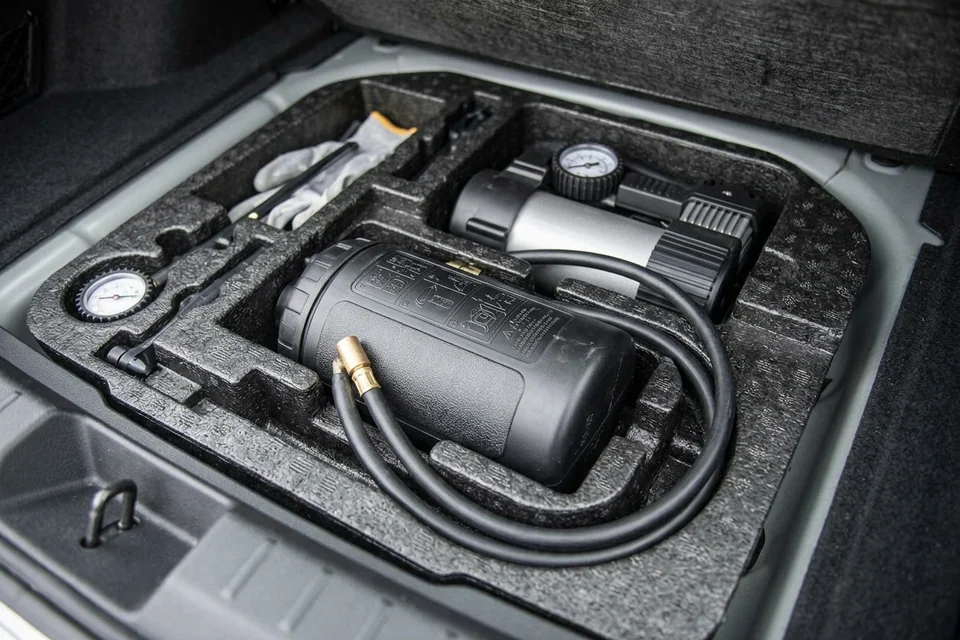
Lift the trunk floor or the cargo mat. A foam tray with a small compressor and a bottle of sealant is the kit. A narrow tire is a compact spare. If there is nothing, check the sidewall for run-flat markings or look in the owner's manual.
Do this at home if you can. On the roadside it is still worth a look. Knowing which of the four options you have changes what you tell us on the call.
Right now
What to Do With a Flat and No Spare
- 01
Get off the road
Pull as far off the travel lanes as you can, hazards on. Do not keep driving on a flat unless it is a run-flat.
- 02
Find the damage
A nail in the tread is a kit or repair candidate. A cut, a bulge, or a hole in the sidewall is not. If the tire came apart, skip the kit.
- 03
Decide on the kit
Use the sealant only for a small tread puncture and only to reach a safe place. Tell us if you used it. It changes what we can do.
- 04
Call with a sidewall photo
The photo gives us the size, any run-flat marking, and the damage. Add where the car is and whether sealant went in.
- 05
Hear the plan
Repair on site if the puncture qualifies, a replacement tire where available, or a tow if neither is safe. You get an honest ETA when a technician is available.
The four options
What Each Option Does to the Tire
The inflator and sealant kit
The kit pushes liquid sealant through the valve stem and then inflates the tire. It is built for one case: a small tread puncture with the object still in or just out. It is a temporary fix to get you to help, not a repair.
It does nothing for a sidewall cut, a bulge, a blowout, or a tire that has come off the rim. And it carries a trade-off. The sealant coats the inside of the tire and often the pressure sensor. Many repair shops decline to repair a tire with sealant inside, and the sensor may need cleaning or replacement.
If you use it, tell us when you call. We inspect the tire and tell you honestly whether a repair is still possible or a replacement is the next step.
Run-flat tires
Run-flats have stiff sidewalls that carry the car a limited distance at reduced speed after losing pressure. The tire maker's owner's manual states that limit, and it is often on the sidewall too. On most cars the pressure light is the only warning, so check it when the ride suddenly feels different.
Most run-flats are replaced rather than repaired after being driven with no pressure, because the sidewall carried the load the air used to carry. Use the allowance to reach a safe place, not to finish the trip.
Mobile repair or replacement where the car sits
This is what we do. Call with a sidewall photo and your location. If the puncture is in the tread and within repair limits, we repair it on site. If not, we help with a replacement tire fitted at the car where available. Repair availability depends on tire condition, damage location, tire size, and safety.
We do not promise that a tire in your size is on hand. We talk through options on the call, including whether a replacement can be sourced and when.
A tow to a shop
A tow is the right call when the car is somewhere unsafe to work, when the wheel is damaged, when more than one tire is down, or when no tire in your size is available in time. We say so on the call rather than send a technician to a job that cannot be done safely.
What to tell us on the call
- The tire size, from the sidewall or the sticker inside the driver's door jamb. A photo is enough
- Whether the tire is a run-flat. Markings vary by brand: RFT, ROF, ZP, SSR, DSST, and others
- Whether sealant went into the tire, from your kit or from a can
- Where the car is: a driveway, a lot, a hotel, or a mile marker and direction on the highway
- What happened: a nail, a curb, a bang at speed, or a slow loss over days
Should you buy a spare afterwards
After one roadside with no spare, many drivers want one. A full-size spare matches the other tires and has no speed limit of its own, but it needs trunk space. A compact spare is lighter and carries a speed and distance limit printed on it. Inflatable and folding spares exist for some models and need the manual's instructions.
If you buy one, check that it clears the brake calipers and that the jack and lug wrench fit your car. Check its pressure a few times a year. A spare that sat flat for years is not a spare.
Compare
Sealant Kit, Run-Flat, Mobile Service, or Tow
| Criteria | Sealant kit | Run-flat tire | Mobile repair or replacement | Tow to a shop |
|---|---|---|---|---|
| Works when | A small puncture in the tread and the tire is still on the rim | The tire lost pressure, the sidewall is intact, and you are within the manual's limit | The car is somewhere safe to work and you can send a sidewall photo | The spot is unsafe, the wheel is damaged, or no tire is available in time |
| Does not work when | Sidewall damage, a bulge, a blowout, or a large hole | The tire came apart or the limit has been used up | Traffic is too close to work safely, or more than one tire is down | Rarely. It is the fallback for everything else |
| The tire afterwards | Coated inside. Many shops decline a repair. The sensor may be affected | Usually replaced after running with no pressure | Repaired on site if it qualifies, otherwise replaced where available | Inspected at the shop. Repaired or replaced there |
| Next stop | A technician or a shop, soon. The kit is a bridge | A shop or a mobile replacement before the limit runs out | Often none. You drive away on a safe tire | The shop the tow takes you to |
Works when
- Sealant kit
- A small puncture in the tread and the tire is still on the rim
- Run-flat tire
- The tire lost pressure, the sidewall is intact, and you are within the manual's limit
- Mobile repair or replacement
- The car is somewhere safe to work and you can send a sidewall photo
- Tow to a shop
- The spot is unsafe, the wheel is damaged, or no tire is available in time
Does not work when
- Sealant kit
- Sidewall damage, a bulge, a blowout, or a large hole
- Run-flat tire
- The tire came apart or the limit has been used up
- Mobile repair or replacement
- Traffic is too close to work safely, or more than one tire is down
- Tow to a shop
- Rarely. It is the fallback for everything else
The tire afterwards
- Sealant kit
- Coated inside. Many shops decline a repair. The sensor may be affected
- Run-flat tire
- Usually replaced after running with no pressure
- Mobile repair or replacement
- Repaired on site if it qualifies, otherwise replaced where available
- Tow to a shop
- Inspected at the shop. Repaired or replaced there
Next stop
- Sealant kit
- A technician or a shop, soon. The kit is a bridge
- Run-flat tire
- A shop or a mobile replacement before the limit runs out
- Mobile repair or replacement
- Often none. You drive away on a safe tire
- Tow to a shop
- The shop the tow takes you to
We explain pricing before any work begins. Quotes are estimates until the technician sees the tire.
No spare questions
No Spare Tire Questions
Can you help if I don't have a spare?
Often yes. Call us with the tire size or send a photo of the sidewall. Repair on site if the puncture qualifies, or a replacement tire where available. We talk through options on the call.
What if I don't know my tire size?
No problem. Send a photo of the tire sidewall or the sticker inside the driver's door jamb, and we help you read it.
Can a tire be repaired after using a sealant kit?
Often not. The sealant coats the inside of the tire, and many repair shops decline to patch it. We inspect the tire and tell you honestly. Replacement is the usual outcome, so use the kit only when you have no other way to reach safety.
How far can I drive on a run-flat with no air?
Only as far as the manufacturer allows, at reduced speed. The limit is in your owner's manual and often on the sidewall. Treat it as a way to reach a safe spot, not a way to finish the trip.
Know your setup
Spare Kit Types and Run-Flat Markings
Full-size spare
Matches the other tires and has no speed limit of its own. Takes the most space and still needs its pressure checked.
Compact spare
Narrow, light, and limited. The speed and distance limits are printed on the tire. A bridge to a shop, not a fix.
Learn moreInflator and sealant kit
A small compressor and a bottle of sealant. Tread punctures only, temporary, and it complicates a later repair.
Run-flat tires
Stiff sidewalls carry the car a limited distance at reduced speed with no pressure. Look for RFT, ROF, ZP, SSR, or DSST on the sidewall.
No kit, no spare, no run-flats
Some cars ship with nothing. Your options are mobile service or a tow. Save our number before you need it, and check that a jack and lug wrench are in the car if you ever add a spare.
Spare tire installation covers getting your spare on and inflated. If there is no spare, we talk through repair or replacement on the call.
Call first
What Calling Before You Act Saves You
With no spare, the first move matters more.
A wasted sealant kit
Sealant in a tire that could have been repaired on site often turns a repair into a replacement.
Using up a run-flat's allowance
A call tells you whether help can come to you before you spend the limit driving to find a shop.
A tow you did not need
If the car is in a driveway or a lot and the puncture is in the tread, a repair where it sits may be enough.
The wrong tire
The sidewall photo gives us the size before anyone rolls, so the replacement conversation starts with the right tire.
Keep reading
Related Pages
- All resourcesEvery guide, the glossary, and the cost and mobile-versus-shop pages in one place.
- Flat tire helpThe first five minutes after a flat, with or without a spare.
- Tesla tire repairNo spare, the repair kit, foam liners, jack pads, and Tesla's own options.
- EV tire serviceWhy EV tires differ: weight, torque, foam liners, load ratings, and lift points.
- Roadside tire replacementHow a replacement tire gets fitted where the car sits.
- Spare tire installationFor the day you do have a spare and want it on and inflated.
- Tire pressure warning lightWhat the light means after sealant or after a spare goes on.
- Mobile service or a shopWhen coming to the car makes sense and when a shop is the better call.
- Tire glossaryRun-flat, compact spare, sealant, TPMS, and the other words here.
- Contact and hoursPublished hours and every way to reach us.
No Spare and Stuck Right Now?
Call Emergency Mobile Tire Repair at (352) 531-6319 with a photo of the sidewall and where you are. We talk through repair, replacement, or a tow and give you an honest ETA when a technician is available.
(352) 531-6319