
Truck Tire Repair
Truck Tire Help, From Pickups Up
Pickups, work vans, and light trucks are confirmed, depending on tire size and availability. Medium and heavy trucks are a different job. Call Emergency Mobile Tire Repair with the truck, the tire size, and the load. We tell you what we can do before anyone rolls.
- Confirmed: pickups, work vans, and light trucks on passenger or LT tires
- Ask on the call: dual rear wheels, 19.5-inch wheels, and anything heavier
- Loaded or empty changes the jack and the answer. Tell us
What this service is
What Truck Tire Repair Covers
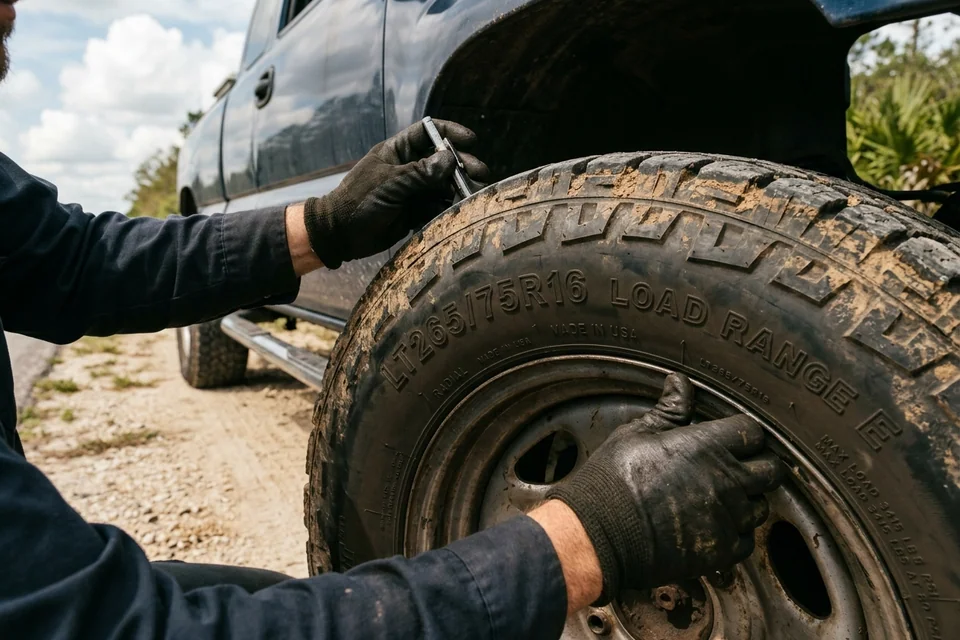
Truck tire repair at the truck means a technician comes to where it stopped and deals with the tire there. For pickups, work vans, and light trucks, that is a tread repair when safe, a spare swap, or help with a replacement.
The line sits at the wheel and the weight. A light truck rides on passenger or LT tires with one wheel at each corner. A medium truck often has dual rear wheels, taller load ranges, and 19.5-inch or larger commercial wheels. That can need equipment a light-duty mobile unit does not carry.
Repair availability depends on tire condition, damage location, tire size, and safety. If the tire cannot be safely repaired, we help with the next best option. We explain pricing before any work begins. Quotes are estimates until the technician sees the tire. Outside our normal range? Call anyway. We may make an exception or point you to the right help.
Why trucks are different
What Makes a Truck Tire a Different Job
LT tires carry a load range
The load range letter on the sidewall says how much the tire carries at its rated pressure. A replacement has to match or exceed it.
Pressure is higher and matters more
Many LT tires run well above passenger pressures at full load. The placard gives the number. Underinflation under load builds heat and fails on the highway.
Duals change everything
Two tires per side share the load. A flat on one overloads the other. An inner dual needs a different wrench reach and a jack rated for the axle.
Heavier means different equipment
Lug torque, wheel weight, and jack capacity climb with truck class. That is why heavier trucks get a yes or no on the call instead of a promise.
By truck type
Truck Tire Help by Truck Type
Pickups
Half-ton through one-ton pickups on passenger or LT tires. Tread repair when safe, your spare, or replacement help.
Learn moreWork vans
Cargo and passenger vans, often loaded with tools or stock. Tell us the load.
Box trucks and cutaway vans
Dual rear wheels and 19.5-inch wheels on many. Call first and we confirm.
Learn moreSemi-trucks
Usually heavier work than a light-duty unit carries. We say so and point you to the right help.
Learn moreSpare installation
Most pickup spares hang under the bed on a cable. We lower it, mount it, and set pressure.
Learn more
How it works
From Your Call to Back on the Job
- 01
Call with the truck, the size, and the load
Make, model, and single or dual rear wheels. Tire size from the sidewall. Loaded or empty. Where it stopped.
- 02
We confirm yes, no, or tow
A pickup or van on LT tires is usually a yes, depending on tire size and availability. Duals and heavier trucks get an honest answer, with an ETA when a technician is available.
- 03
We come to the truck
Fully off the travel lanes on firm ground, hazards on. If the truck is loaded and the shoulder is soft, say so.
- 04
Repair, spare, or replacement, then pressure
The technician inspects the tire, explains the options and the cost, and does the work you approve. Pressure goes to the placard before the truck moves.
Decide
Light, Medium, or Heavy: Where Your Truck Falls
| Criteria | Light truck (confirmed) | Medium truck (ask on the call) | Heavy truck (likely a referral) |
|---|---|---|---|
| Typical examples | Half-ton to one-ton pickups, cargo vans, small utility trucks | Box trucks, cutaway vans with duals, larger service bodies | Semi-trucks, dump trucks, anything on 22.5-inch wheels |
| Wheels and tires | Single wheels, passenger or LT tires | Often dual rear wheels, 19.5-inch commercial tires on many | 22.5-inch or larger commercial tires on heavy wheels |
| What we can say before rolling | Yes, depending on tire size and availability | Yes, no, or tow, after you tell us the vehicle, size, and load | Usually a referral to a commercial truck tire service |
Typical examples
- Light truck (confirmed)
- Half-ton to one-ton pickups, cargo vans, small utility trucks
- Medium truck (ask on the call)
- Box trucks, cutaway vans with duals, larger service bodies
- Heavy truck (likely a referral)
- Semi-trucks, dump trucks, anything on 22.5-inch wheels
Wheels and tires
- Light truck (confirmed)
- Single wheels, passenger or LT tires
- Medium truck (ask on the call)
- Often dual rear wheels, 19.5-inch commercial tires on many
- Heavy truck (likely a referral)
- 22.5-inch or larger commercial tires on heavy wheels
What we can say before rolling
- Light truck (confirmed)
- Yes, depending on tire size and availability
- Medium truck (ask on the call)
- Yes, no, or tow, after you tell us the vehicle, size, and load
- Heavy truck (likely a referral)
- Usually a referral to a commercial truck tire service
Know before you call
Truck Tire Facts That Change the Call
Read the sidewall and the placard
The sidewall gives the size, the LT or P marking, the load range letter, and the DOT date code. The door jamb placard gives the gross vehicle weight rating and the pressure for the front and rear tires, which are often different on a truck. A photo of each answers most of our questions.
Why the loaded weight matters
A tire that is fine on an empty truck can be overloaded on a full one. Tire Industry Association guidance ties load capacity to pressure. A soft tire under a heavy load builds heat and fails. The same weight decides whether a jack can lift the axle safely.
Dual rear wheels
Duals are common on one-ton pickups and most trucks above them. When one goes flat, its partner carries the whole load for that side and heats up. An inner dual is harder to see and harder to reach. Tell us single or dual on the call. It changes the tools and sometimes the answer.
Where to stop with a truck
- Fully off the travel lanes, on firm, level ground. A jack rated for the axle still sinks into a soft shoulder
- Hazards on. Stand on the side away from traffic
- Do not drive on a flat. It shreds the tire, can damage the wheel, and on a dual overloads the other tire
Our published hours are on the contact page. After-hours calls are answered depending on technician availability.
What we can confirm today, and what to ask on the call
- Vehicles the site lists: cars, SUVs, pickups, work vans, light trucks, and trailers, depending on tire size and availability.
- Flat repair by patch, plug, or seal when safe, spare installation, and roadside tire replacement labor.
- Trailer tire assistance and mobile tire mounting are listed where available.
- Pricing is explained before work begins, and quotes are estimates until the technician inspects the vehicle.
- Service across Lake, Orange, Osceola, Polk, Seminole, and Sumter counties.
Ask on the call:
- Which trucks beyond pickups, work vans, and light trucks, including dual rear wheels and 19.5-inch wheels
- Fleet terms for repeat work on several vehicles
- Balancing on site
Questions drivers ask
Truck Tire Repair Questions
Do you service SUVs, trucks, or trailers?
Yes. Cars, SUVs, pickups, vans, light trucks, and trailers, depending on tire size and availability. Medium and heavy trucks are confirmed on the call before anyone rolls.
Can you repair a tire on a truck with dual rear wheels?
Ask on the call. Tell us the truck, the tire size, and whether the flat is the inner or outer dual. We confirm before dispatching.
Should I drive a loaded truck on a flat tire?
No. Driving on a flat damages the tire and the wheel, and on a dual it overloads the other tire. Pull over on firm ground, put on hazards, and call us.
Keep reading
Related Services and Pages
- Commercial tire serviceEvery work vehicle type: confirmed, ask on the call, or referral.
- Box truck tire repairDuals, 19.5-inch wheels, and loading dock flats.
- RV tire serviceAge and weight decide most motorhome calls.
- Semi-truck tiresWhy most semi-truck tire work needs heavier equipment.
- Trailer tire assistanceThe trailer behind the truck, where available.
- Fleet tire serviceWhat to keep on file for several trucks.
- Plug and patch repairWhich punctures can be fixed on any tire.
- Check your service areaEnter a ZIP or city to see if we cover you.
Truck Tire Down? Call With the Size and the Load
Call Emergency Mobile Tire Repair at (352) 531-6319. Tell us the truck, single or dual, the tire size, and what it is carrying. We tell you yes, no, or tow before anyone rolls.
(352) 531-6319