
Low-Profile Tire Replacement
Low-Profile Tire Damaged? Tell Us the Wheel Size First
A pothole or a curb can finish a low-profile tire in one hit. Emergency Mobile Tire Repair replaces tires where the car sits, but stiff, short sidewalls are harder to mount at the roadside. Call with the wheel and tire size first.
- Replacement labor at the car, where mobile mounting is available for your wheel and tire
- Some large-wheel combinations need shop equipment. We say so on the call
- A photo of the sidewall gives us the size
- Spare install where there is a spare, so you can move meanwhile
What makes this different
Why a Low-Profile Tire Is Its Own Job
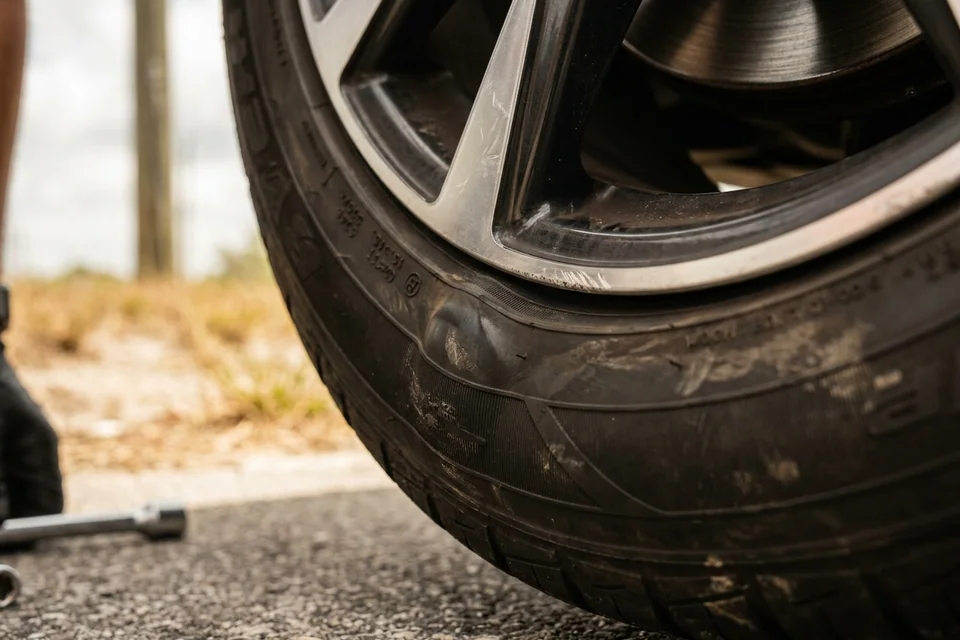
A low-profile tire has a short sidewall, the rubber between the rim and the road. Less sidewall means less cushion. A pothole edge or a curb can pinch the tire against the rim and cut it, or bend the wheel.
That same stiff sidewall makes the tire hard to mount. It resists stretching over the rim, and the bead needs a strong push of air to seat. On a large wheel the risk of marking the rim goes up.
Mobile tire mounting is offered where available. Whether your combination can be done at the car depends on wheel diameter, tire size, equipment, and technician availability. We confirm that on the call.
Why call first
What the Call Settles Before a Technician Rolls
A yes or no on mounting
Wheel diameter and tire size decide whether the job can be done on site. You hear the answer before a technician rolls.
No forced mount on an expensive wheel
A rim marked or bent during a roadside mount is a second problem. If the risk is too high, we say so.
Wheel checked along with the tire
Pothole and curb hits bend wheels as often as they cut tires. The rim is inspected before anything is mounted.
A way to move in the meantime
If the car has a spare, installing it now gets you off the shoulder. Watch the limits printed on it.
What to tell us
What We Need to Know on the Call
Have these ready, or send a photo and we read it with you.
Tire size from the sidewall
The string that looks like 245/35R20. The last number is the wheel diameter in inches. The middle number is the sidewall height. Lower means stiffer.
What hit the tire, and the wheel finish
A pothole, a curb, or debris. Say whether the wheel looks bent, the tire has a bulge, or the rim has a polished lip that marks easily.
Whether you already have a replacement
A tire in the trunk or on order nearby changes the plan. Give us the size so we can check it against the placard.
Learn moreRun-flat or not
Some low-profile tires are also run-flats. The sidewall marking tells us. That combination is the hardest to mount at the roadside.
Learn more
Repair availability depends on tire condition, damage location, tire size, and safety.
How it works
From the Call to a Mounted Tire or a Clear Answer
- 01
Call with the size and a photo
Read the sidewall or send a photo. Tell us the wheel diameter and what happened.
- 02
We tell you on site or shop
Based on the wheel, the tire, and the equipment, we say whether the mount can be done at the car.
- 03
Wheel and tire inspected first
The rim is checked for bends and cracks before anything is mounted.
- 04
Mount, inflate, torque, or the next step
The tire goes on, pressure is set to the placard, and the lug nuts are torqued. If not, the spare gets you to a shop.
Decide
Mount at the Car or Go to a Shop?
| Criteria | Mount at the car | Spare now, shop later | Straight to a shop |
|---|---|---|---|
| Fits when | The combination can be mounted on site and the rim is straight | You have a usable spare and the wheel or tire needs shop equipment | The wheel is bent, or you want balancing and alignment in one visit |
| What drives the cost | The labor at the car and where the tire comes from | The spare install now, the shop's charges later | The tow if there is no spare, plus the shop's work |
| The risk to avoid | Forcing a mount that marks or bends the rim | Driving the compact spare past its printed limits | Driving on the damaged tire to get there |
Fits when
- Mount at the car
- The combination can be mounted on site and the rim is straight
- Spare now, shop later
- You have a usable spare and the wheel or tire needs shop equipment
- Straight to a shop
- The wheel is bent, or you want balancing and alignment in one visit
What drives the cost
- Mount at the car
- The labor at the car and where the tire comes from
- Spare now, shop later
- The spare install now, the shop's charges later
- Straight to a shop
- The tow if there is no spare, plus the shop's work
The risk to avoid
- Mount at the car
- Forcing a mount that marks or bends the rim
- Spare now, shop later
- Driving the compact spare past its printed limits
- Straight to a shop
- Driving on the damaged tire to get there
We explain pricing before any work begins. Quotes are estimates until the technician sees the tire.
Know before you call
Low-Profile and Large-Wheel Tires Explained
Why these tires fail on a pothole or curb
On a standard tire the sidewall flexes and absorbs the edge of a pothole. On a low-profile tire the impact goes into the tire and the wheel together. The usual results are a pinch cut, a bulge where the inner cords broke, or a bent rim. A bulge or any sidewall cut is a replacement, not a repair.
Why mounting them at the roadside is harder
Mounting means stretching the bead over the rim and seating it with air. A short, stiff sidewall resists both. Large wheels add leverage problems and more rim surface to protect. Some combinations need a shop machine, and we say so on the call.
Check the wheel, not just the tire
A hit hard enough to cut a low-profile tire often bends the wheel too. Signs are a new vibration, air loss with no puncture, or a flat spot on the rim edge. A new tire on a bent wheel leaks at the bead.
Matching the replacement, and when a shop is the right call
Match size, load index, and speed rating to the door placard. Keep both tires on an axle the same. Go to a shop when the wheel is damaged or the combination cannot be mounted on site. The same goes if you want alignment too. A spare install gets you there without driving on the damaged tire.
Questions drivers ask
Low-Profile Tire Questions
Can you mount a low-profile tire at the roadside?
Sometimes. It depends on wheel diameter, tire size, equipment, and technician availability. Tell us the size and we give you a yes or no before anyone rolls.
What if I don't know my tire size?
No problem. Send a photo of the tire sidewall or call us and we help you read it.
Do you repair tires or replace them?
Both, when safe. A tread puncture inside repair limits can often be repaired on site. A pinch cut, a bulge, or any sidewall damage means replacement.
Should I drive on a flat tire?
No. Driving on a flat damages the tire and wheel. Pull over safely, put on hazards, and call us.
Keep reading
Related Services and Guides
- Mobile tire replacementThe parent page.
- Run-flat tire replacementThe other stiff-sidewall tire.
- Tesla tire repairNo spare, the repair kit, foam liners, jack pads, and Tesla's own options.
- EV tire serviceWhy EV tires differ: weight, torque, foam liners, load ratings, and lift points.
- Spare tire installationGet the spare on now.
- Sidewall damage guidePinch cuts and bulges explained.
- Mobile service or a shop?When each is the better call.
- Check your service areaEnter a ZIP or city.
Low-Profile Tire Damaged? Call With the Wheel Size
Call Emergency Mobile Tire Repair at (352) 531-6319 with the tire size, the wheel diameter, and what hit it. We tell you what can be done on site and give you an honest ETA when a technician is available.
(352) 531-6319